Filter the Audit Log Filter logs
Rule-based filtering includes or excludes events using these attributes:
- User account
- Audit event class
- Audit event subclass
- Audit event fields (for example,
COMMAND_CLASSorSTATUS)
Which classes and subclasses you can target depends on audit_log_filter.event_mode. Validated names appear in Audit Log Filter definition fields.
Define multiple filters and assign any filter to multiple accounts, or register a default filter for accounts without a specific row. You define filters through SQL function calls.
After you define a filter, the server persists it in mysql system tables.
Audit Log Filter functions
The six management UDFs in the following table — audit_log_filter_flush(), audit_log_filter_set_filter(), audit_log_filter_remove_filter(), audit_log_filter_set_user(), audit_log_filter_remove_user(), and audit_log_rotate() — require the AUDIT_ADMIN privilege.
The reader UDFs (audit_log_read(), audit_log_read_bookmark()), the session-id helper (audit_log_session_filter_id()), and the keyring helpers (audit_log_encryption_password_get(), audit_log_encryption_password_set()) do not require AUDIT_ADMIN. The keyring helpers require an initialized keyring component or plugin.
These functions drive rule-based filtering:
| Function | Description | Example |
|---|---|---|
| audit_log_filter_flush() | Flush filter tables and reload definitions into the component | SELECT audit_log_filter_flush(); |
| audit_log_filter_set_filter() | Create or replace a named filter | SELECT audit_log_filter_set_filter('log_connections', '{ "filter": {} }'); |
| audit_log_filter_remove_filter() | Drop a named filter | SELECT audit_log_filter_remove_filter('filter-name'); |
| audit_log_filter_set_user() | Bind a filter to a user account | SELECT audit_log_filter_set_user('user-name@localhost', 'filter-name'); |
| audit_log_filter_remove_user() | Clear filter bindings for a user account | SELECT audit_log_filter_remove_user('user-name@localhost'); |
Through SQL, you define, inspect, and change audit log filters; definitions live in the mysql system database.
audit_log_session_filter_id() returns the active audit log filter ID for the current session.
Filter definitions are JSON values.
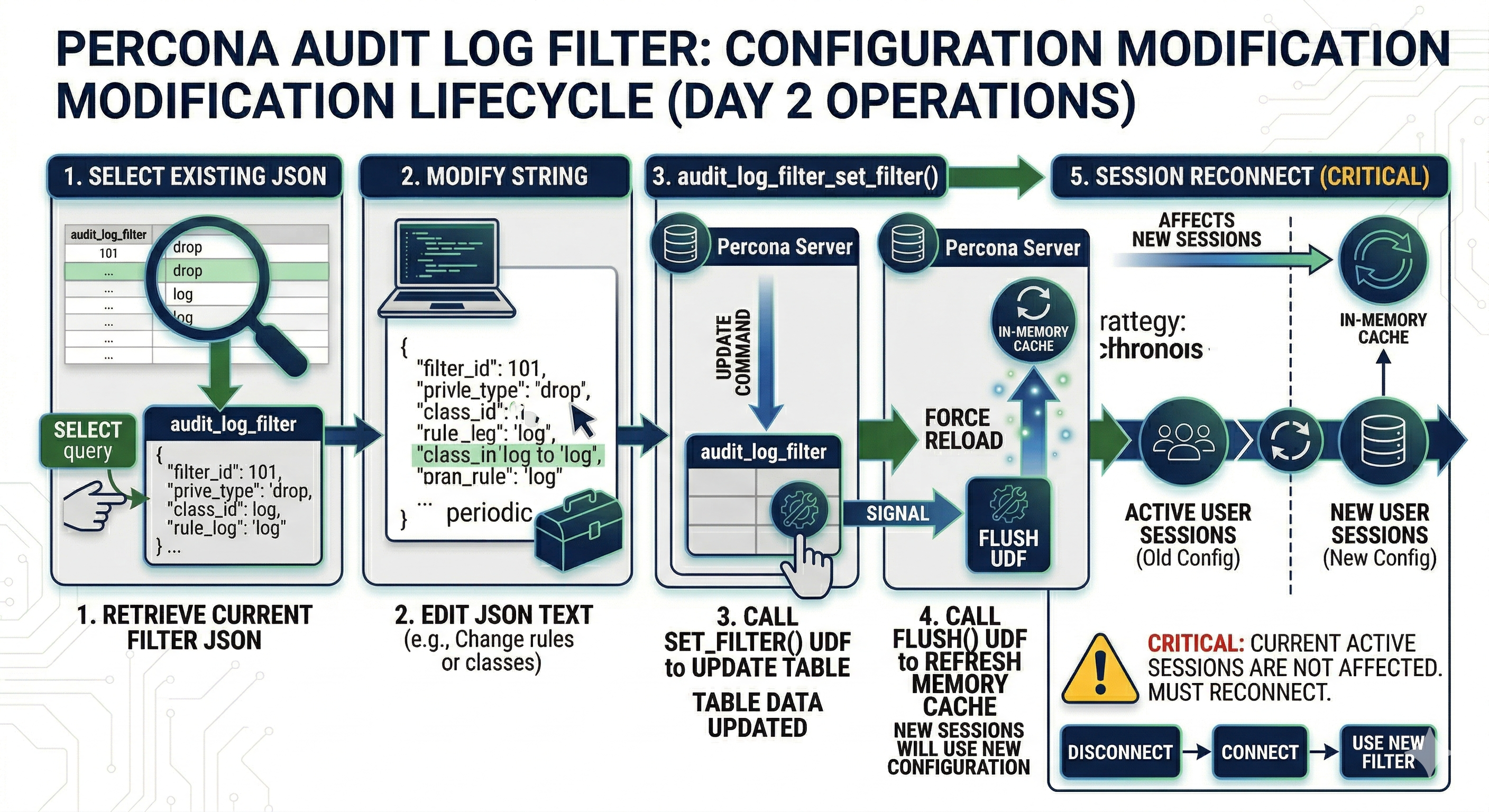
Reloading rules from tables, persistence after audit_log_filter_set_filter(), and post-flush session behavior are covered under audit_log_filter_flush() and Persistence and refreshing in Audit log filter functions, options, and variables.
Filter modification lifecycle
The following diagram shows how filter changes persist, reload into the component, and reach sessions, including when audit_log_filter_flush() runs.
Constraints
Enable the component_audit_log_filter component and ensure audit tables exist before calling audit log filter functions. The account must hold the required privileges.
Filter definition validation
Introduced in Percona Server for MySQL 8.4.9-9.
The server validates filter definitions at parse time and rejects invalid input with a clear error:
-
Unknown field names (e.g.,
"WRONG.str") -
Invalid class or event subclass names
-
Empty arrays (e.g.,
"class": []) -
Unknown JSON keys (e.g.,
"classes"instead of"class","events"instead of"event","names"instead of"name","logs"instead of"log") -
printrules that reference invalid fields for any class in a multi-class array -
Mismatched field types (e.g., negative values for unsigned fields, integers where only strings are allowed)
An empty filter object {} is equivalent to {"filter": {"log": true}} and logs every event. To log nothing, use {"filter": {"log": false}}.
Behavior before 8.4.9-9
Before 8.4.9-9, the parser silently ignored unknown keys. Misspelling a structural key caused the parser to skip that entire subtree and fall back to the default. For example, the filter {"filter": {"classes": [...]}} (note classes instead of class) was parsed as {"filter": {}}, which logs every event. No error was returned, and the filter appeared to succeed. The same applied to events instead of event, names instead of name, and logs instead of log. Upgrade to 8.4.9-9 or later to catch these mistakes at parse time.
Parse-phase subclass names must use preparse and postparse.
audit_log_filter.event_mode controls which classes new definitions may use; filters saved under FULL can still load under REDUCED with some classes skipped (see that variable).
Using the audit log filter functions
Assignment vs rules inside the JSON
Two mechanisms apply, in order:
-
Assignment (
mysql.audit_log_user) — Each session uses one named filter from theUSERandHOSTcolumns (the sameuser_name@host_nameform you pass toaudit_log_filter_set_user()). The server loads that filter’s JSON frommysql.audit_log_filter. Assignments do not merge: a session never evaluates two separate filter definitions at once. -
Rules inside the assigned JSON —
logconditions on a class or event block narrow which events match within the already-selected filter. Conditions compare event fields (such asuser.str,host.str,table_database.str,table_name.str,status) withfielditems, and combine them withand/or/not. They are not a second user- or host-level assignment row. For example, bind one filter to'app'@'%'and still include alogcondition under aconnectionrule so only connection events from chosen client hosts are logged.
See Test event field values and Combine conditions with logical operators for the grammar used in rule-level conditions.
Which audit_log_user row applies
On connect, the component selects a row in mysql.audit_log_user whose USER and HOST match the session account. Literal user@host pairs match when they equal the session identity. Starting in Percona Server for MySQL 8.4.4, wildcard characters (% and _) are allowed in the host portion of the assignment string (see audit_log_filter_set_user()); pattern matching matches the behavior when you create the row through that function.
Keep assignments non-overlapping when you use wildcards. If several rows could match one connection, precedence is not specified here—prefer explicit literal user@host rows (or one clear pattern plus a '%' default) and confirm behavior on a test server.
With no matching row, the component uses the default assignment: the account registered with audit_log_filter_set_user() using % as the user name (see audit_log_filter_set_user()).
If neither a matching row nor a default exists, the component skips event processing for that connection.
A specific account row overrides the default: if both admin@localhost and % have filters, admin from localhost uses the admin@localhost filter, not the default.
You can bind filters to named accounts or remove those bindings.
To clear a binding, unassign the filter or assign a different one. How sessions refresh when assignments change is described under audit_log_filter_set_user() and audit_log_filter_remove_filter().
set_filter options and available filters
JSON layout (filter, class, nested rules, examples) is in Write audit_log_filter definitions. The authoritative list of class names, event subclass names, and per-class field names that audit_log_filter_set_filter() accepts appears in Audit Log Filter definition fields. This section lists the keys that may appear at each level of a filter definition.
Filter-level keys
| Key | Role |
|---|---|
log |
Boolean global default. true enables logging everywhere not turned off by a more specific rule; false requires per-class/per-event log overrides to write anything. |
class |
One class block or an array of class blocks. Each block sets "name" to an event class (general, connection, table_access, message; plus global_variable, command, query, stored_program, authentication, parse when event_mode=FULL). |
id |
Optional filter identifier. Referenced by activate / ref when one filter swaps itself for another mid-session (see Replace a filter dynamically). |
Class-block keys
| Key | Role |
|---|---|
name |
The class name. Use one of the values listed in the preceding section. |
log |
Optional. Boolean, or a condition that narrows matches by event-field values. |
event |
Optional. One event block or an array. Each block names one subclass and can carry its own log, abort, print, or nested filter. Subclasses depend on the class. For table_access: read, insert, update, delete. For connection: connect, disconnect, change_user, plus pre_authenticate in FULL. See the event and subclass table and definition fields. |
print |
Optional. Field-replacement rule. The component limits replacement to general_query.str and query.str with the query_digest function. See Redact audit log fields. |
Event-block keys
| Key | Role |
|---|---|
name |
Subclass name. May be a string (one subclass) or an array (several). |
log |
Optional. Boolean, or a condition over event fields. |
abort |
Optional. Boolean or condition that blocks execution of matching statements — see Block statements with an audit log filter. |
print |
Optional. Field-replacement rule scoped to this event — see Redact audit log fields. |
filter |
Optional. Nested subfilter used with activate / ref for dynamic filter swapping — see Replace a filter dynamically. |
Conditions
log and abort accept a Boolean (true / false) or a condition built from these items:
| Item | Role |
|---|---|
field |
{ "name": "<event-field>", "value": <value> }. Compares an event field such as user.str, host.str, table_database.str, table_name.str, status, general_command.str, or general_sql_command.str. Per-class fields are listed in Audit Log Filter definition fields. |
variable |
{ "name": "<server-variable>", "value": <value> }. Compares a predefined variable such as audit_log_connection_policy_value. |
function |
{ "name": "<function>", "args": [...] }. Calls a built-in. The Percona implementation supports two functions: string_find and query_digest — see Reference predefined functions. |
and |
Array of sub-conditions; all must be true. |
or |
Array of sub-conditions; at least one must be true. |
not |
A single sub-condition; true when the inner evaluates to false. |
Field-value typing (JSON numbers for integer fields such as status, strings for *.str fields, and "::tcp/ip"-style symbolic constants for connection_type) is covered under audit_log_filter_set_filter() and in the connection section of Audit Log Filter definition fields.
Examples
Start from a single-class filter that logs every connection event the component sees:
SELECT audit_log_filter_set_filter('log_connection', '{
  "filter": {
    "class": { "name": "connection" }
  }
}');
Narrow to a single subclass by nesting event inside the class block (not as a sibling of class):
SELECT audit_log_filter_set_filter('log_connect_only', '{
  "filter": {
    "class": {
      "name": "connection",
      "event": { "name": "connect" }
    }
  }
}');
Narrow further by adding a log condition that tests event fields — here, log connect events from only two accounts, originating from one host:
SELECT audit_log_filter_set_filter('log_admin_connect', '{
  "filter": {
    "class": {
      "name": "connection",
      "event": {
        "name": "connect",
        "log": {
          "and": [
            { "field": { "name": "user.str", "value": ["admin", "developer"] } },
            { "field": { "name": "host.str", "value": "10.0.0.5" } }
          ]
        }
      }
    }
  }
}');
For full authoring detail, see:
- Write audit_log_filter definitions — inclusive and exclusive patterns, conditions, and the complete grammar
- Audit Log Filter definition fields — canonical class, event, and field names validation accepts
audit_log_filter.event_mode—REDUCEDversusFULLclass sets